Meditations
Book 1
Philosophy~24 min
Never dealt in this demo yet
Unshelve
what the page begins, the road makes real
Your shelf, dealt back to you — start anywhere. Three chapters on your forgetting curve; read one, and your notes come back as recall cards.
The demo deck · 2 sample books · 20 chapters
Meditations
Book 1
Never dealt in this demo yet
— add your own books when you're ready. The two books in this deck are already on it.
Recall card · days after reading
“The best kind of revenge is, not to become like unto them.”
Meditations · Book 6 · a saved highlight
Days later, the card asks
What did Marcus call the best kind of revenge?
Answering schedules its next return.
Notes and highlights return as cards like this, spaced along your forgetting curve.
The deck above is the real dealing engine. What it can't show: upload your own book, read, leave a one-line note — and days later the note comes back as a card. Twenty seconds, silent.
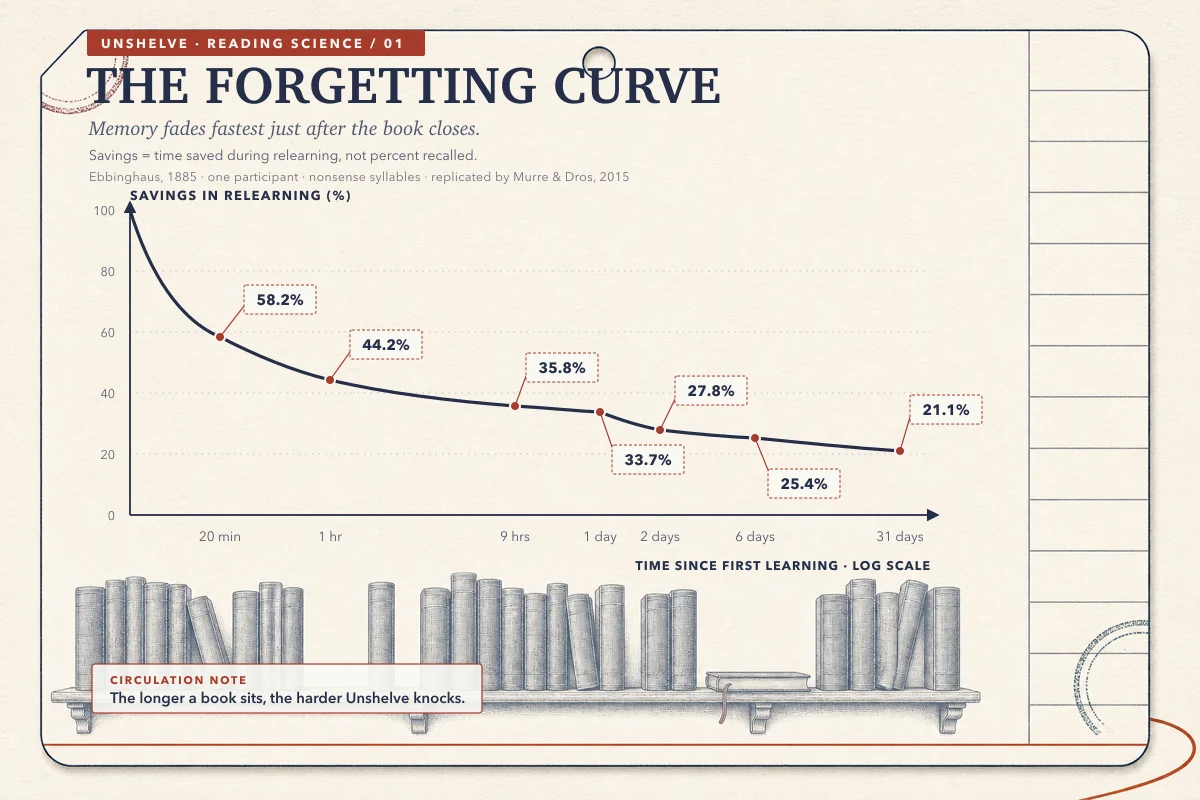
Ebbinghaus measured it on himself in 1885; a 2015 replication found the same shape. Unshelve schedules each book's return against this curve — the longer one sits, the harder it knocks.
Ebbinghaus (1885); replicated by Murre & Dros (2015), PLOS ONE 10(7).
A week out, the tested group kept half again as much as the re-readers. So your notes come back as questions, not as text to skim.
Roediger & Karpicke (2006), Psychological Science 17(3), 249–255.
61%
retained a week later by the tested group
vs 40% for re-readers
63%
on the delayed test after mixed practice
vs 20% for blocked practice
Mixed practice feels worse while you do it — and wins the delayed test by a wide margin. Random chapters from across your shelf are that mix, scattered on purpose.
Rohrer & Taylor (2007), Instructional Science 35, 481–498.
— the shelf comes stocked; the evidence comes cited.
Incremental reading has worked since the 1990s. It has just never been usable. SuperMemo proved the method; Kindle resurfaces highlights; Readwise tunes their frequency; interleave.app interleaves the extracts you clip. Unshelve's bet: skip the clipping — deal whole chapters of your own files (EPUB, PDF, Markdown), in a web app that follows you onto every device.
Unshelve just launched, and it's built by one person — for my own shelf first, because my books were losing to my feeds. Two things I can promise: every claim on this page carries its citation, and you'll find no testimonials below because there are no users to quote yet. You'd be early. That's the honest pitch.
— add your own books when you're ready.


